

IGF DES
Dhs. 300.00
Skip to product information
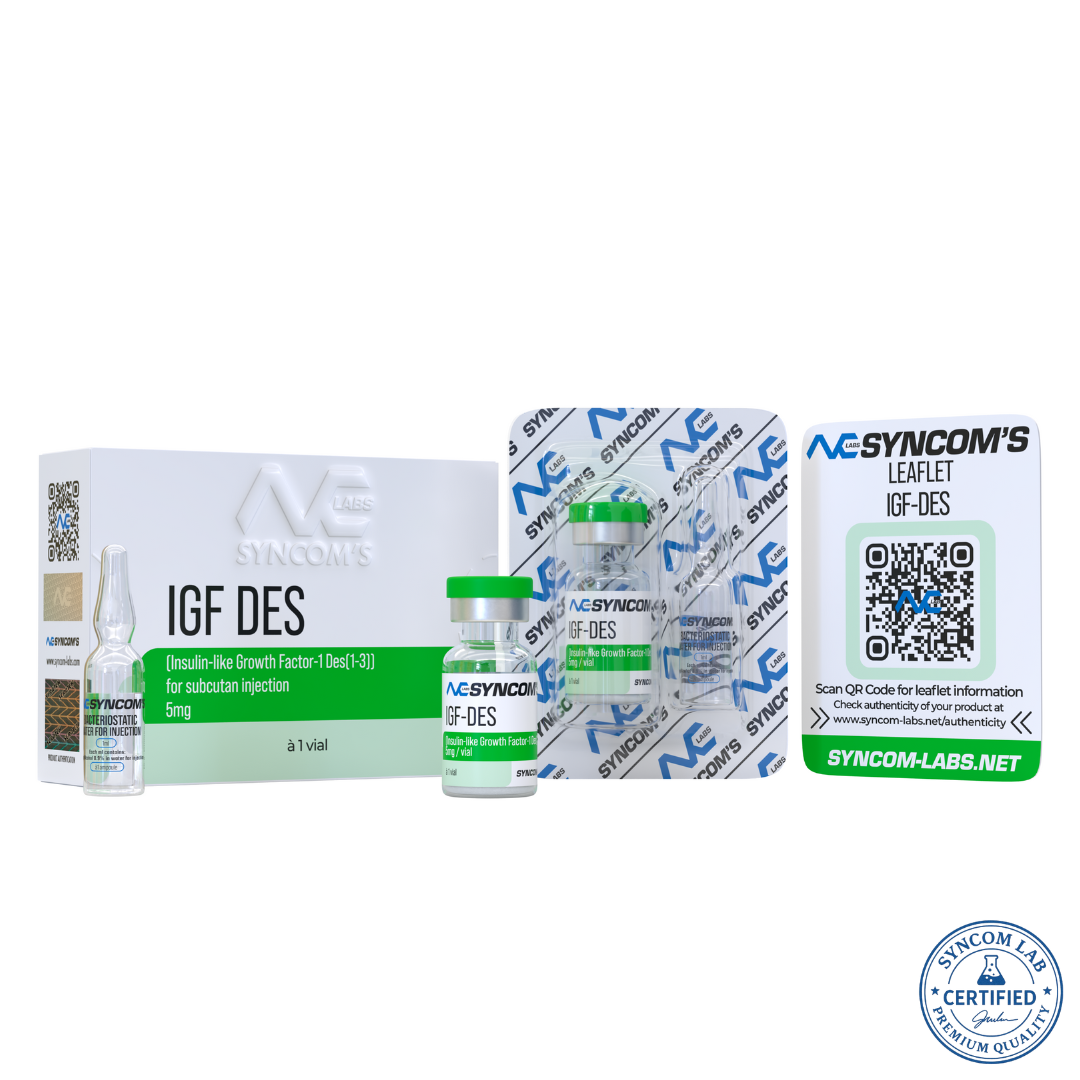

IGF DES
Dhs. 300.00
IGF‑1 DES (Des(1‑3)IGF‑1) is a bioactive fragment of insulin‑like growth factor‑1 (IGF‑1) that retains strong affinity for IGF‑1 receptors but has reduced binding to IGF binding proteins (IGFBPs). This biochemical profile allows more rapid receptor signaling and site‑specific activity, making it useful in research protocols focusing on muscle satellite cell activation, localized anabolic signaling, repair, and tissue regeneration. ([turn0search23])
⚗️ Product Features
-
🧪 Truncated IGF‑1 variant with enhanced receptor availability
-
⚙️ Designed for targeted anabolic and regenerative signaling
-
📈 Supports muscle growth and repair pathways in research models
-
✅ ≥98 % purity verified by HPLC
-
📄 Batch‑specific Certificates of Analysis (COAs) included
-
💧 Sterile, lyophilized peptide for research applications
🔬 Human‑Relevant Research Applications
💪 IGF‑1 Pathways in Muscle Growth & Repair
IGF‑1 plays a critical role in human skeletal muscle biology, where it enhances satellite cell proliferation, differentiation, and muscle regeneration via the IGF‑1 receptor and downstream PI3K/Akt signaling — pathways closely linked to protein synthesis and cellular growth.
🔗 https://pubmed.ncbi.nlm.nih.gov/25002025/ — IGF‑1 is a key facilitator of muscle growth, satellite cell activation, and repair in human muscle tissue and is under study for its roles in enhancing muscle anabolism and regenerative processes.
About IGF‑1 DES: The truncated form (DES) has reduced IGFBP binding and shorter half‑life (~20–30 min), allowing rapid, intense receptor interaction and localized anabolic signaling where applied — a reason it’s often used for targeted site effect in research settings.
🧾 Mechanism Summary
-
📈 Activates IGF‑1 receptor signaling to support protein synthesis and satellite cell activation
-
⚙️ Enhances local anabolic signaling with rapid receptor engagement
-
🩹 Supports muscle repair and regeneration pathways following cellular stress or mechanical loading
-
🔬 Different profile than full‑length IGF‑1 due to decreased IGFBP binding and focused action
🔄 Reconstitution & Handling Guidance
1️⃣ Reconstitute with sterile bacteriostatic water
2️⃣ Add the appropriate volume per your research protocol
3️⃣ Gently swirl until fully dissolved — avoid vigorous shaking
4️⃣ Store reconstituted peptide at 4–10 °C
5️⃣ Refrigerate unopened vials when not in use
❓ Frequently Asked Research Questions
How does IGF‑1 influence muscle growth in humans?
IGF‑1 engages IGF‑1 receptors on muscle cells, activating signaling cascades like PI3K/Akt, which promote satellite cell proliferation, differentiation, and protein synthesis, key processes for muscle growth and repair.
What makes IGF‑1 DES different from regular IGF‑1?
IGF‑1 DES lacks the first three amino acids of IGF‑1, which reduces binding to IGF binding proteins (IGFBPs) and enhances receptor interaction and local anabolic signaling, making it suitable for targeted research on muscle repair and hypertrophic responses in specific tissues.